
Sprouted vs Regular Legumes: Is There Really a Difference?
Chances are your grandmother already knew the answer to this one.
In Indian kitchens, women have been soaking and sprouting lentils for generations. Nobody explained the science behind it. It was simply how you cooked. I grew up watching my mother and grandmother do it, and a jar of soaking beans on the bench was as ordinary as the salt.
Nobody thought of it as a health practice….it was just the preparation step before cooking.
The science has since caught up, and it turns out those women were onto something.
What actually happens when you sprout a legume?
There are two stages, and each one does something different.
Activation is the soak. Depending on the legume, beans sit in water for anywhere from four to twenty-four hours, with the water changed a few times along the way. Those water changes matter more than people realise. Leave the water too long and bacteria take hold, it starts to smell, and the legumes spoil.
Sprouting comes next. The bean starts to grow small shoots, and as it does, it begins breaking itself down.
The way it works is a bit like a lock and key. Phytic acid is the lock: the compound a seed uses to keep its minerals in storage until it's ready to grow. When you soak and sprout the seed, an enzyme called phytase switches on and acts as the key. It breaks down the phytic acid, which frees up the iron, zinc and calcium that were trapped inside. Once they're free, your body can absorb them much more easily, so you get more out of the same bean.
All it takes is water and time. No special equipment and no additives.
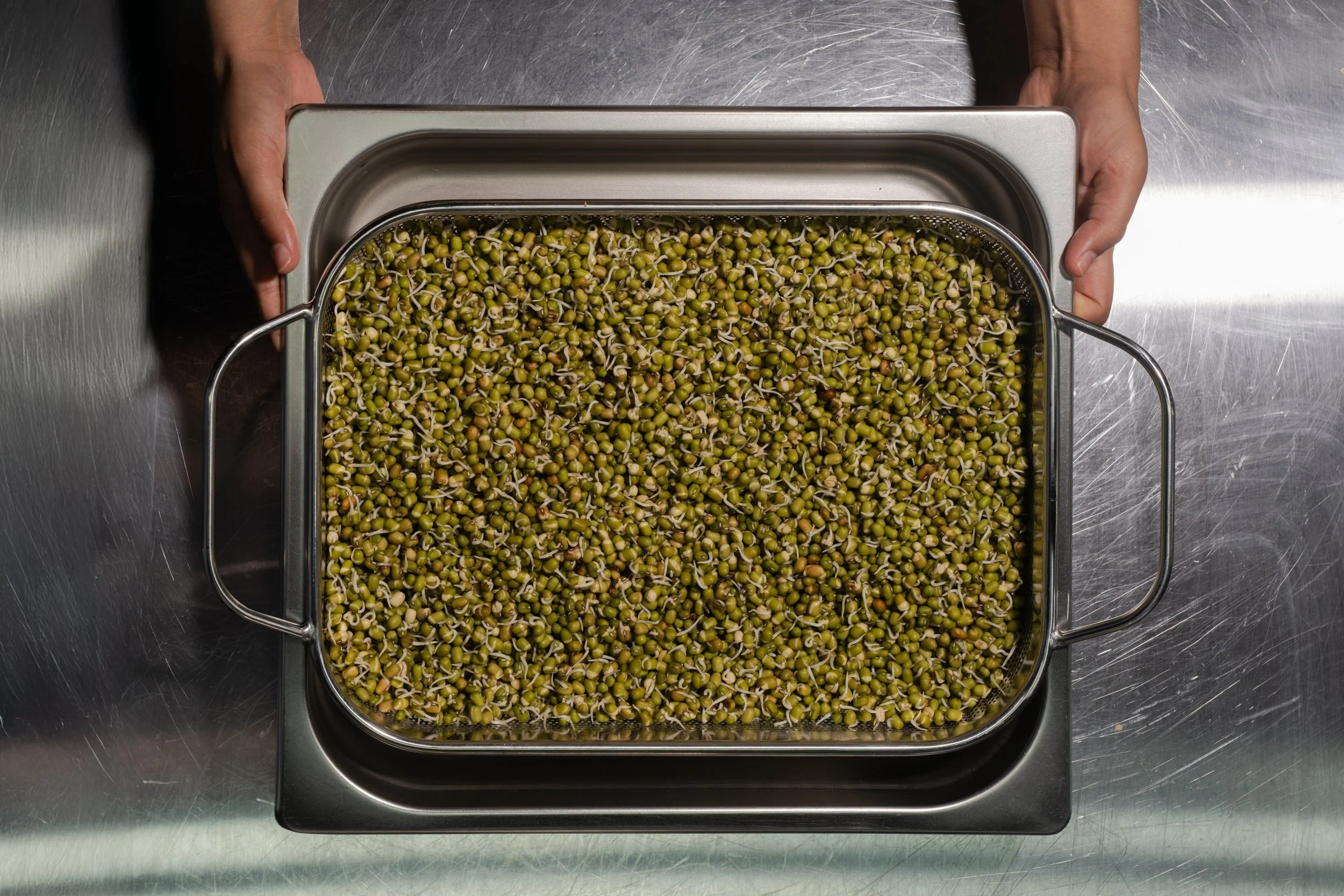
Green moong beans, sprouted and ready. The little white shoots show the bean has started to grow.
Does sprouting change the taste?
People often ask whether sprouting changes the taste. It doesn't.
There's an assumption that anything labelled sprouted or activated will taste bland, dry, a bit earthy, like health food.
In reality a sprouted lentil tastes like a lentil. The flavour in a finished meal comes from what happens next: the spices and the long, slow cooking.
So you won't taste the difference. Where you'll notice it is in how you feel afterwards.
Why do beans give you gas? (And how sprouting changes it)
Beans have a reputation, and it's not entirely unfair. A lot of people find they sit heavily, cause bloating and make themselves known for the rest of the evening.
The cause has a clunky name: oligosaccharides.
These are carbohydrates made from sugar molecules linked together in a chain, and that chain is the problem. Humans don't make the enzyme needed to break that particular link, so these sugars pass through the small intestine undigested. When they reach the large intestine, your gut bacteria ferment them, and gas is the by-product. That's why beans have been called the musical fruit.
Soaking starts to deal with this. Oligosaccharides are water soluble, so over a few hours they leach out into the water, and the water changes carry them away.
Sprouting does the rest. As the bean starts to grow, it uses the remaining stored sugars as fuel. Between the two stages, oligosaccharide content can drop by around 50 to 70%, depending on the legume and how long it's sprouted.
By the time the bean reaches your plate, most of that hard work is done. You still get the fibre, protein and minerals, without the discomfort afterwards.
Sprouting boosts antioxidants
This was the part that surprised me most when I started reading into it.
A dry bean is dormant. It's a seed waiting for the right conditions, and while it waits, most of its processes are switched off.
Once it's soaked, it comes back to life. A germinating seed is quite vulnerable: it's suddenly active, exposed to oxygen, and it needs to protect its new growth. So it produces antioxidant compounds to defend itself, and a lot of them. Levels can rise many times over compared with the dry bean.
The bean is doing this for its own protection, and we get the benefit when we eat it.
That's really what sprouting is. You're not adding anything to the bean. You're waking it up and letting it do the work.
More than one kind of fibre
There's another benefit that rarely gets mentioned.
Sprouted legumes naturally contain resistant starch, a type of starch that isn't digested in the small intestine and travels on to the colon, where it feeds your gut bacteria. That's on top of the soluble fibre legumes already contain, which forms a gel, slows digestion and helps release sugar into the blood more steadily.
So you're getting two types of fibre, each doing a different job. Most people think of fibre as one thing that keeps you regular, but there's a lot more to it than that.
The protein becomes easier to use
Legumes are a good source of protein, but in a dry bean that protein is tightly packed into storage proteins, put away for when the seed starts to grow.
Your body can't use protein in that form. It first has to break those long chains down into individual amino acids, which are what it absorbs and uses to build muscle, enzymes and everything else. That takes work, and your digestive system has to start from scratch.
A sprouting bean gets that process started. To fuel its growth, it produces enzymes that break its stored proteins into shorter chains and free amino acids. In doing so, it hands you protein that's already partly broken down.
So the amino acids are more freely available by the time the meal reaches you. There isn't more protein on the label, but there's less standing between you and the protein that was always there.
So, is there really a difference?
Yes, though not in the way most people expect.
You won't taste it, and it won't show up as a big change on the label. The difference is in what your body can do with the food once you've eaten it.
The nutrients on paper are the same. Far more of them reach you.
Why we never cook a bean straight from the packet
Every legume in a Gut Happy meal is activated and sprouted before it goes near a pot. It's slow, it has to be watched, and if the timing's off we lose a batch to mould or spoilage. It adds days to something that could take twenty minutes.
We do it because it's what makes food good for you in practice, not just on paper.
COMMON QUESTIONS
-
Generally, yes. Activating and sprouting start breaking the bean down before you eat it, so your digestive system has less work to do. Both stages also reduce oligosaccharides, the chained sugars your body can't digest, which your gut bacteria ferment into gas. They're water soluble, so soaking draws them out, and the sprouting bean uses up most of what's left.
-
For most people, much less. Between soaking and sprouting, oligosaccharide content can drop by 50 to 70%, which removes most of the cause. Everyone's gut is different, though, so if you haven't been eating much fibre, start with smaller portions and build up.
-
No. Soaking is the step that comes before sprouting, so once a legume has sprouted, that part is done.
-
No. A sprouted lentil tastes like a lentil. The flavour comes from the spices and the slow cooking.
-
They're two separate stages. Activation is the soak, which runs four to twenty-four hours depending on the legume, with the water changed a few times. Sprouting comes after, when the bean starts to grow small shoots. For some legumes, activation alone is enough. Others need both.